Lumièrophone Demo from The Amazing Rolo on Vimeo.
Thursday, October 22, 2009

Tuesday, October 20, 2009
"SNIFF'
I missed the work of Video artist Karolina Sobecka in Brooklyn in sept. 09 but here is an interesting interactive public projection.
Sniff from karolina sobecka on Vimeo.
Conductive thread
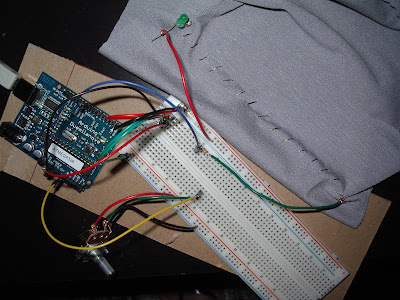
I received this afternoon the conductive thread and conductive pen I ordered. Here is my first try simply with a potentiometer, a LED and conductive thread (hand sewn & machine). It worked!


Sunday, October 18, 2009
Interactive media installations seem to be frequently used in museum environments.
Observation of interactive technology in public, used by multiple people
Couple weeks ago I was at the MAD (Museum of Art and Design) and found myself enjoying the interactive screens on different floors. I was really impressed with this fresh way of using interactive displays to solve information design problems. Museums are getting better at drawing the audience in to find out more about there exhibits and this example puts interactive displays in the same space as the Apple i-phone interface.
When you enter, there are screens mapping every floor of the museum. What I enjoyed particularly is the touch screens in each room that give you a quick access to the highlights of the collection and even the entire catalog. Visitors can control the amount of information they are given and access much more details about the different objects. These easy-to-use screens facilitate and entertain the visitors, who have the impression to be part of the exhibition. The screens are pretty big and easy to use by touching with your hand or fingers. It allows you to navigate through different objects complementary to the exhibit. I observe that mainly the young adults and children are using the touch screens. But occasionally, the older museum fanatics were really curious to try the new devices. The program is really straight forward and easy to follow. The transactions between images and menu are quick, almost instantaneous. This new technology allows its users to interact with the objects. It also builds a new relationship between the visitors and the museum environment.

Directional totem in the museum's lobby, part of the program of dynamic media created by Lisa Strausfeld and team. Lisa Strausfeld Featured in Fast Company’s 2009 Masters of Design
Couple weeks ago I was at the MAD (Museum of Art and Design) and found myself enjoying the interactive screens on different floors. I was really impressed with this fresh way of using interactive displays to solve information design problems. Museums are getting better at drawing the audience in to find out more about there exhibits and this example puts interactive displays in the same space as the Apple i-phone interface.
When you enter, there are screens mapping every floor of the museum. What I enjoyed particularly is the touch screens in each room that give you a quick access to the highlights of the collection and even the entire catalog. Visitors can control the amount of information they are given and access much more details about the different objects. These easy-to-use screens facilitate and entertain the visitors, who have the impression to be part of the exhibition. The screens are pretty big and easy to use by touching with your hand or fingers. It allows you to navigate through different objects complementary to the exhibit. I observe that mainly the young adults and children are using the touch screens. But occasionally, the older museum fanatics were really curious to try the new devices. The program is really straight forward and easy to follow. The transactions between images and menu are quick, almost instantaneous. This new technology allows its users to interact with the objects. It also builds a new relationship between the visitors and the museum environment.

Directional totem in the museum's lobby, part of the program of dynamic media created by Lisa Strausfeld and team. Lisa Strausfeld Featured in Fast Company’s 2009 Masters of Design
Wednesday, October 7, 2009
“The Psychopathology of everyday things”
The author talks about the frustrations facing everyday designs. He illustrates a variety of examples of poorly designed products, making you wondering and analyzing objects around you. He believes: “When simple things need pictures, labels, or instructions, the design has failed.” The fundamental principles of Design for Understandability and Usability are providing a good conceptual model and making things visible. In the rest of his work, the author shares his observations critiquing daily used products.
The author continues by explaining the principle of “mapping” which is defined by “a technical term meaning the relationship between two things; between the controls and their movements and the results in the world.” Then, the principle of “feedback” is explained as the action of “sending back to the user information about what action has actually been done, what result has been accomplished.”
Before creating a perfect product it usually takes 5 or 6 attempts to get it right. The functionality needs to be tested and improve until entire satisfaction.
The author continues by explaining the principle of “mapping” which is defined by “a technical term meaning the relationship between two things; between the controls and their movements and the results in the world.” Then, the principle of “feedback” is explained as the action of “sending back to the user information about what action has actually been done, what result has been accomplished.”
Before creating a perfect product it usually takes 5 or 6 attempts to get it right. The functionality needs to be tested and improve until entire satisfaction.
Stupid Pet Trick
“NO WAY”: Comical but yet a practical device.

This analog circuit is constructed using a Force resistor sensor and a LED. When the sensor is activated by the individual, the LED brightens up, lighting the little black box. We then discover the words: NO WAY. This device has been created to communicate a straight forward message. This would eliminate uncomfortable and potentially long lasting exchanges with undesirable people. In the context of a bar or other social venues, this device could prove to be very useful.
Preferably, I would have needed more LEDs or a much brighter one. This “Stupid Pet Trick” could potentially, with improvement, become a practical object.


This analog circuit is constructed using a Force resistor sensor and a LED. When the sensor is activated by the individual, the LED brightens up, lighting the little black box. We then discover the words: NO WAY. This device has been created to communicate a straight forward message. This would eliminate uncomfortable and potentially long lasting exchanges with undesirable people. In the context of a bar or other social venues, this device could prove to be very useful.
Preferably, I would have needed more LEDs or a much brighter one. This “Stupid Pet Trick” could potentially, with improvement, become a practical object.


LAb: servo/analog out

I couldn't make the circuit work. I'll have to try again, but here is the pic of what I did...
Subscribe to:
Posts (Atom)